
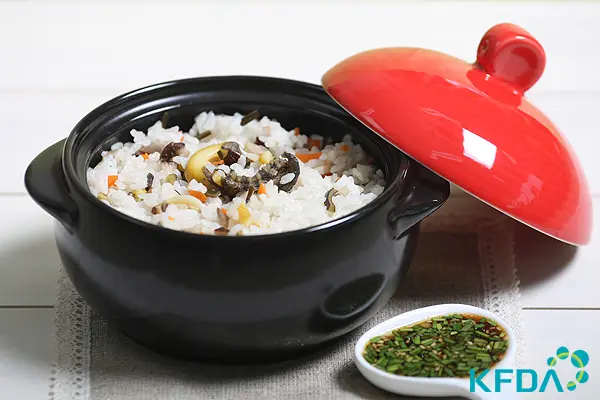
Photo: Korea Ministry of Food and Drug Safety
 South Korea
Abalone Nutritious Rice with Garlic Chive Seasoning Sauce
전복영양밥과 부추양념장
Rice · Boiled
RiceCourse
387kcal · per serving
Not spicySpice
No pork
Recipe
Abalone Nutritious Rice with Garlic Chive Seasoning Sauce
Not spicyNo porkNo meat or alcoholContains: gluten, soy, sesame, shellfish
Ingredients Tap an ingredient to check it off
Servings1
- Abalone nutritious rice: rice전복영양밥 : 쌀90 g
- abalone meat전복살40 g
- button mushrooms양송이 버섯13 g
- shiitake mushrooms표고버섯15 g
- carrot당근15 g
- dried kelp건다시마5 g
- water물400 g
- garlic chives (buchu)부추5 g
- soy sauce간장5 g
- thin scallion (silpa)실파2.5 g
- minced garlic다진 마늘2.5 g
- sesame oil참기름0.5 g
- sesame seeds통깨0.5 g
Nutrition per serving
387kcal
77.5gCarbs
12.8gProtein
1.9gFat
459.9mgSodium
Steps
Translated from the Korean original. Amounts are as in the original recipe.
- Put the dried kelp in 2 cups of water and make about 1 and a half cups of kelp broth.
- Finely mince the steeped kelp and the abalone meat.
- Cut the shiitake mushrooms, button mushrooms, and carrot into 0.5 to 0.7 cm dice.
- Wash the rice, add the ingredients from steps 2 and 3, pour in 1 and a half cups of kelp broth, soak for about 30 minutes, and cook the rice.
- Mince the garlic chives and scallion and make a seasoning sauce with sesame oil, minced garlic, sesame seeds, kelp broth, and soy sauce.
- Serve the abalone nutritious rice with the garlic chive seasoning sauce.
💡 TipScrub the surface of the abalone with a brush to wash it, hold the shell in one hand and scoop out the meat with a spoon starting from the thin side, then remove the bluish innards and the hard beak. - When slicing abalone meat, lay it diagonally so it does not slip and cuts easily. - Mix the kelp broth and soy sauce 1:1.
Diet and allergy labels are estimated from the ingredient list. Check labels if you have an allergy.
Recipe source: Korea Ministry of Food and Drug Safety (MFDS) recipe database. English translation by WorldFoodPedia, not by MFDS.
Community recipes
No community recipes yet.
Sign in to share recipes, rate and comment.
Share your recipe for Abalone Nutritious Rice with Garlic Chive Seasoning Sauce
More dishes from South Korea
View all Recipe
BibimbapKorean rice bowl dish
 Recipe
BulgogiMarinated, grilled Korean beef dish
 Recipe
GimbapKorean seaweed roll
 Recipe
KimchiTraditional Korean dish of fermented vegetables
 Recipe
TteokbokkiSouth Korean dish made from rice and flour cakes
 Recipe
NaengmyeonKorean dish of cold noodles
 Recipe
GalbiGrilled beef or pork ribs in Korean cuisine
 Recipe
JapchaeKorean dish of stir-fried glass noodles and vegetables