
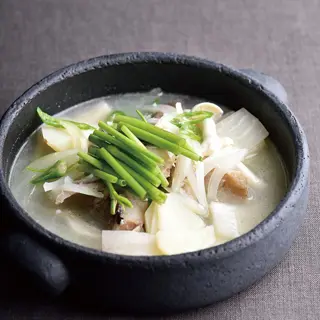
Photo: Korea Ministry of Food and Drug Safety
 South Korea
Clear Half-Dried Pollock Soup (Kodari Malgeun Tang)
코다리맑은탕
Soup & stew · Boiled
Soups & stewsCourse
162kcal · per serving
3/5Spice
🌱 Vegan
Recipe
Clear Half-Dried Pollock Soup (Kodari Malgeun Tang)
🌶 Spicy 3/5VeganContains: gluten, soy, sesame
Ingredients Tap an ingredient to check it off
Servings1
Shopping in
- half-dried pollock (kodari)코다리200 g
- Korean radish (mu)무60 g↔ No Korean radish (mu)? Daikon is the closest. Turnip works in soups.🛒 Where to buy: Daikon is in many supermarkets and all Asian grocery stores
- potato감자60 g
- onion양파15 g
- Korean green chili pepper (cheongyang gochu)청양고추30 g
- Korean water dropwort (minari)미나리25 g
- white king oyster mushrooms (baekil songi)백일송이버섯25 g
- sesame oil참기름15 g
- Broth: minced garlic국물 : 다진마늘15 g
- low-sodium soy sauce저염간장15 g
- white pepper흰후추1 g
Nutrition per serving
162kcal
7.7gCarbs
24.2gProtein
3.9gFat
110.8mgSodium
Steps
Translated from the Korean original. Amounts are as in the original recipe.
- Cut the half-dried pollock into bite-sized pieces, rinse in water, and drain.
- Cut the potato, radish, white king oyster mushrooms, and Korean water dropwort into bite-sized pieces.
- Cut the onion and green chili pepper into bite-sized pieces too.
- Add sesame oil to a pot and lightly stir-fry the pollock.
- Add the radish, potato, and broth ingredients to the pot used for the pollock and boil thoroughly.
- Top the boiling soup with the onion, green chili pepper, and white king oyster mushrooms to finish.
💡 TipThe clear broth is not heavily salted; reduced-sodium soy sauce provides the savory depth. The radish and potato replace saltiness with a soft, chewy texture.
Diet and allergy labels are estimated from the ingredient list. Check labels if you have an allergy.
Recipe source: Korea Ministry of Food and Drug Safety (MFDS) recipe database. English translation by WorldFoodPedia, not by MFDS.
Community recipes
No community recipes yet.
Sign in to share recipes, rate and comment.
Share your recipe for Clear Half-Dried Pollock Soup (Kodari Malgeun Tang)
More dishes from South Korea
View all Recipe
BibimbapKorean rice bowl dish
 Recipe
BulgogiMarinated, grilled Korean beef dish
 Recipe
GimbapKorean seaweed roll
 Recipe
KimchiTraditional Korean dish of fermented vegetables
 Recipe
TteokbokkiSouth Korean dish made from rice and flour cakes
 Recipe
NaengmyeonKorean dish of cold noodles
 Recipe
GalbiGrilled beef or pork ribs in Korean cuisine
 Recipe
JapchaeKorean dish of stir-fried glass noodles and vegetables