

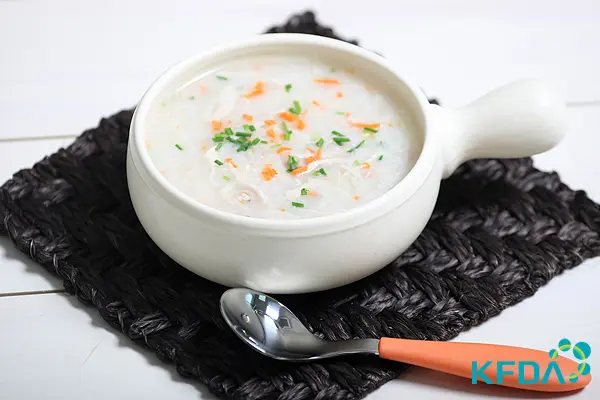
Photo: 국립국어원, CC BY-SA 2.0 kr, Wikimedia Commons
 South Korea

Dakjuk
닭죽
Korean chicken porridge dish
About this dish
Juk is a Korean porridge dish that is made by boiling rice or other grains or legumes, such as beans, sesame, nuts, and pumpkin. Juk is often eaten warm, especially as a morning meal, but can also be eaten at any time of the day. Depending on the ingredients and consistency, juk can be considered as food for recuperation, a delicacy, or famine food. It is known to have nutritional benefits, and is considered to be beneficial to digestion because of its soft texture. It is a staple "get well" dish; a dish to eat when one is sick or recovering from bad health. Juk is also considered an ideal food for babies, the ill or elderly, as it is easily eaten and digested. It is also sold commercially by many chain stores in South Korea, and is a common takeout dish.
Description: Wikipedia — Dakjuk, CC BY-SA 4.0
Chicken Porridge Made with Leftover Rice
Ingredients Tap an ingredient to check it off
- leftover cold rice찬밥60 g
- chicken thigh meat닭다리살80 g
- potato감자30 g
- whole garlic cloves통마늘15 g
- onion양파10 g
- carrot당근8 g
- garlic chives (buchu)부추5 g
- water물700 g
- salt소금0.75 g
- ground black pepper후춧가루0.3 g
Nutrition per serving
Steps
Translated from the Korean original. Amounts are as in the original recipe.
- Remove the fat from the chicken thighs, pour 3 and a half cups of water into a pot, and boil them with the whole garlic cloves to make a broth.
- Strain the boiled garlic through a sieve, mash it, and return it to the broth.
- Add the cold rice to 2 and a half cups of the chicken broth and boil until the rice grains are soft.
- Debone the boiled chicken thigh meat, shred it finely, and add it.
- Finely mince the potato, onion, carrot, and garlic chives.
- Add the ingredients from step 5 to step 4, boil, and season with salt and black pepper.
Diet and allergy labels are estimated from the ingredient list. Check labels if you have an allergy.
Recipe source: Korea Ministry of Food and Drug Safety (MFDS) recipe database. English translation by WorldFoodPedia, not by MFDS.
Community recipes
No community recipes yet.
Sign in to share recipes, rate and comment.
Share your recipe for Dakjuk
More dishes from South Korea
View all Recipe
 Recipe
 Recipe
 Recipe
 Recipe
 Recipe
 Recipe
 Recipe