
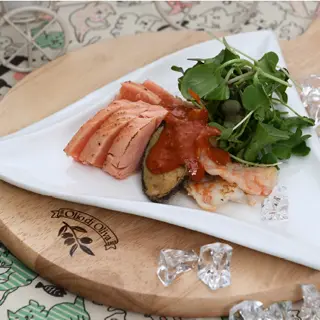
Photo: Korea Ministry of Food and Drug Safety
 South Korea
Shrimp Rolls and Abalone Salad with Mustard Sauce (Gyeoja Sauce Saeu Roll and Jeonbok Salad)
겨자소스를 곁들인 새우롤과 전복샐러드
Side dish
Side dishesCourse
379kcal · per serving
2/5Spice
No pork
Recipe
Shrimp Rolls and Abalone Salad with Mustard Sauce (Gyeoja Sauce Saeu Roll and Jeonbok Salad)
🌶 Spicy 2/5No porkNo meat or alcoholContains: dairy, gluten, soy, fish, shellfish
Ingredients Tap an ingredient to check it off
Servings1
Shopping in
- shrimp새우(3 whole)
- abalone전복(2 pcs)
- salmon연어(100g)100 g
- mustard powder겨자가루(20g)20 g
- baby greens어린잎(30g)30 g
- yogurt요구르트(20g)20 g
- gochujang (Korean chili paste)고추장(30g)30 g↔ No gochujang (Korean chili paste)? Sriracha or another chili paste with a little miso and honey gets close. It won’t have the same fermented depth.🛒 Where to buy: Most large supermarkets now carry it in the Asian aisle; Korean grocery stores have more brands
- sugar설탕(10g)10 g
- vinegar식초(10g)10 g
- salt소금(1g)1 g
Nutrition per serving
379kcal
1.5gCarbs
45.9gProtein
21.1gFat
330.4mgSodium
Steps
Translated from the Korean original. Amounts are as in the original recipe.
- Peel the shrimp, slice them into sheets, and boil until cooked.
- Remove the abalone from the shells with a spoon, wash with salt, and grill in a heated pan.
- Slice the salmon into sheets.
- Mix the mustard powder with water at about 30 C evenly and let it ferment, then add the sugar and vinegar to make the mustard sauce.
- Add the yogurt to the gochujang to make the gochujang sauce.
- Put the cooked shrimp, abalone, and salmon on a plate, top with the mustard sauce and gochujang sauce, and decorate with baby greens.
💡 TipAdding yogurt to gochujang makes the flavor milder and also lowers the sodium.
Diet and allergy labels are estimated from the ingredient list. Check labels if you have an allergy.
Recipe source: Korea Ministry of Food and Drug Safety (MFDS) recipe database. English translation by WorldFoodPedia, not by MFDS.
Community recipes
No community recipes yet.
Sign in to share recipes, rate and comment.
Share your recipe for Shrimp Rolls and Abalone Salad with Mustard Sauce (Gyeoja Sauce Saeu Roll and Jeonbok Salad)
More dishes from South Korea
View all Recipe
BibimbapKorean rice bowl dish
 Recipe
BulgogiMarinated, grilled Korean beef dish
 Recipe
GimbapKorean seaweed roll
 Recipe
KimchiTraditional Korean dish of fermented vegetables
 Recipe
TteokbokkiSouth Korean dish made from rice and flour cakes
 Recipe
NaengmyeonKorean dish of cold noodles
 Recipe
GalbiGrilled beef or pork ribs in Korean cuisine
 Recipe
JapchaeKorean dish of stir-fried glass noodles and vegetables