
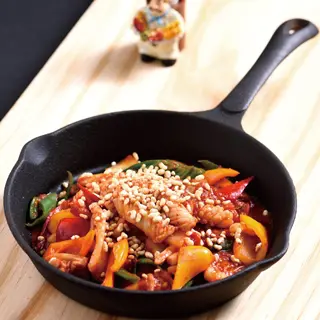
Photo: Korea Ministry of Food and Drug Safety
 South Korea
Stir-fried Squid (Ojingeo Gui)
오징어구이
Side dish · Stir-fried
Side dishesCourse
278kcal · per serving
5/5Spice
No pork
Recipe
Stir-fried Squid (Ojingeo Gui)
🌶 Spicy 5/5No porkNo meat or alcoholContains: gluten, soy, sesame, shellfish
Ingredients Tap an ingredient to check it off
Servings1
Shopping in
- squid오징어300 g
- mini bell peppers미니파프리카40 g
- onion양파50 g
- green chili pepper청고추15 g
- red chili pepper홍고추15 g
- Seasoning sauce: minced garlic양념장 : 다진마늘15 g
- gochugaru (Korean chili flakes)고춧가루15 g↔ No gochugaru (Korean chili flakes)? Mix 2 parts sweet paprika with 1 part cayenne or red pepper flakes. Less smoky and a bit hotter, so start with half.🛒 Where to buy: Korean or Asian grocery stores (H Mart, Lotte Plaza), the international aisle of large supermarkets, or online
- whole peeled tomatoes홀토마토50 g
- gochujang (Korean chili paste)고추장15 g↔ No gochujang (Korean chili paste)? Sriracha or another chili paste with a little miso and honey gets close. It won’t have the same fermented depth.🛒 Where to buy: Most large supermarkets now carry it in the Asian aisle; Korean grocery stores have more brands
- sugar설탕15 g
- oligosaccharide syrup올리고당15 g
- pepper후추1 g
- sesame oil참기름15 g
- Garnish: roasted brown rice고명 : 볶은 현미15 g
Nutrition per serving
278kcal
24.8gCarbs
22.9gProtein
9.7gFat
611.4mgSodium
Steps
Translated from the Korean original. Amounts are as in the original recipe.
- Score the squid in a pinecone pattern.
- Cut the mini bell peppers, onion, and green and red chili peppers into suitable sizes.
- Stir-fry the minced garlic, then add the squid and stir-fry.
- Add the whole peeled tomatoes and the seasoning sauce ingredients and stir-fry.
- Let the pan scorch slightly to add a smoky, fiery flavor and heat.
- Plate and sprinkle with roasted brown rice to finish.
💡 TipWhole peeled tomatoes are used in place of gochujang to reduce sodium intake.
Diet and allergy labels are estimated from the ingredient list. Check labels if you have an allergy.
Recipe source: Korea Ministry of Food and Drug Safety (MFDS) recipe database. English translation by WorldFoodPedia, not by MFDS.
Community recipes
No community recipes yet.
Sign in to share recipes, rate and comment.
Share your recipe for Stir-fried Squid (Ojingeo Gui)
More dishes from South Korea
View all Recipe
BibimbapKorean rice bowl dish
 Recipe
BulgogiMarinated, grilled Korean beef dish
 Recipe
GimbapKorean seaweed roll
 Recipe
KimchiTraditional Korean dish of fermented vegetables
 Recipe
TteokbokkiSouth Korean dish made from rice and flour cakes
 Recipe
NaengmyeonKorean dish of cold noodles
 Recipe
GalbiGrilled beef or pork ribs in Korean cuisine
 Recipe
JapchaeKorean dish of stir-fried glass noodles and vegetables