
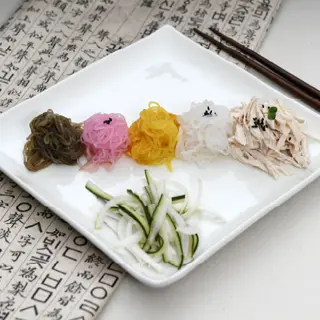
Photo: Korea Ministry of Food and Drug Safety
 South Korea
Cold Chicken Soup with Mustard and Four-Color Konjac (Chogye-tang)
초계탕과 사색곤약
Side dish · Boiled
Side dishesCourse
100kcal · per serving
Not spicySpice
No porkGluten-free
Recipe
Cold Chicken Soup with Mustard and Four-Color Konjac (Chogye-tang)
Not spicyNo porkGluten-freeContains: shellfish
Ingredients Tap an ingredient to check it off
Servings1
- chicken닭고기(1 whole)
- Siberian ginseng (gasi-ogapi)가시오가피(10g)10 g
- green onion대파(20g)20 g
- kelp (dasima)다시마(10g)10 g
- dried shrimp건새우(20g)20 g
- shirataki konjac noodles실곤약(100g)100 g
- beet비트(30g)30 g
- gardenia powder (chija)치자가루(10g)10 g
- garlic마늘(20g)20 g
- salt소금(0.3g)0.3 g
- ground black pepper후춧가루(0.01g)0.01 g
- onion양파(50g)50 g
- cucumber오이(50g)50 g
- mustard powder겨자가루(10g)10 g
- vinegar식초(20g)20 g
- sugar설탕(20g)20 g
Nutrition per serving
100kcal
7.7gCarbs
15.4gProtein
0.9gFat
54.4mgSodium
Steps
Translated from the Korean original. Amounts are as in the original recipe.
- Clean the chicken well and cut it into parts.
- Put the Siberian ginseng, green onion, kelp, garlic, and dried shrimp in a pot and simmer gently, then add the chicken, boil for about 20 minutes, remove it, and shred the meat.
- Julienne the onion and cucumber and quick-pickle them with vinegar, sugar, and salt.
- Mix mustard powder with water at about 30°C (86°F) evenly and let it ferment, then add sugar, vinegar, and salt to make a mustard sauce.
- Place the white konjac, the konjac mixed with beet and gardenia powder, and julienned kelp on a plate.
- Arrange the pickled onion and cucumber and the shredded chicken on one side, and add the mustard sauce just before eating.
💡 TipThe natural seasoning components in kelp and dried shrimp can take the place of sodium.
Diet and allergy labels are estimated from the ingredient list. Check labels if you have an allergy.
Recipe source: Korea Ministry of Food and Drug Safety (MFDS) recipe database. English translation by WorldFoodPedia, not by MFDS.
Community recipes
No community recipes yet.
Sign in to share recipes, rate and comment.
Share your recipe for Cold Chicken Soup with Mustard and Four-Color Konjac (Chogye-tang)
More dishes from South Korea
View all Recipe
BibimbapKorean rice bowl dish
 Recipe
BulgogiMarinated, grilled Korean beef dish
 Recipe
GimbapKorean seaweed roll
 Recipe
KimchiTraditional Korean dish of fermented vegetables
 Recipe
TteokbokkiSouth Korean dish made from rice and flour cakes
 Recipe
NaengmyeonKorean dish of cold noodles
 Recipe
GalbiGrilled beef or pork ribs in Korean cuisine
 Recipe
JapchaeKorean dish of stir-fried glass noodles and vegetables