

Photo: Hyeon-Jeong Suk, CC BY 2.0, Wikimedia Commons
 South Korea

Jang-jorim
장조림
Korean dish made of beef and soy sauce
About this dish
Jang-jorim (Korean: 장조림) is a Korean side dish consisting of lean beef braised in soy sauce with eggs. Jang-jorim is a type of jorim, a Korean simmered dish that preserves well. The side dish is commonly packed in lunch boxes in South Korea and is sold at South Korean convenience stores as a lunchtime dish. The dish can also be made using mushrooms, quail eggs, and green peppers.
Description: Wikipedia — Jang-jorim, CC BY-SA 4.0
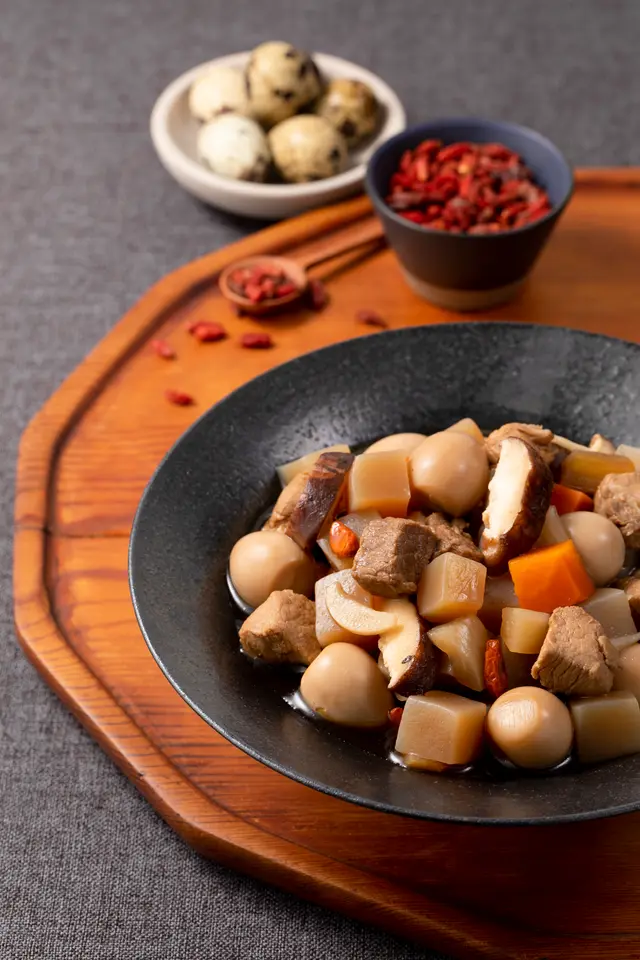
Goji Berry Mixed Jangjorim (Soy-braised Meat and Eggs)
Ingredients Tap an ingredient to check it off
- Pork (shank)한돈(사태)(shank)30 g
- Quail eggs메추리알30 g
- Carrot당근10 g
- Konjac곤약10 g
- Goji berries (gugija)구기자5 g
- Onion양파10 g
- Scallion파10 g
- Dried kelp (dasima)다시마5 g
- Garlic마늘10 g
- Shiitake mushrooms표고버섯10 g
- Low-sodium soy sauce저염간장15 g
Nutrition per serving
Steps
Translated from the Korean original. Amounts are as in the original recipe.
- Prepare the pork shank, cut it into cubes, and wash.
- Wash the onion, scallion, kelp, shiitake mushrooms, and garlic and cut into suitable sizes, and cut the carrot and konjac into cubes.
- Prepare a braising liquid in a pot with water and low-sodium soy sauce in a 2:1 ratio.
- Add the goji berries, onion, scallion, kelp, shiitake mushrooms, and garlic to the braising liquid and boil.
- When the braising liquid boils, add the pork shank, quail eggs, carrot, and konjac and braise.
- Serve on a plate to finish.
Diet and allergy labels are estimated from the ingredient list. Check labels if you have an allergy.
Recipe source: Korea Ministry of Food and Drug Safety (MFDS) recipe database. English translation by WorldFoodPedia, not by MFDS.
Community recipes
No community recipes yet.
Sign in to share recipes, rate and comment.
Share your recipe for Jang-jorim
More dishes from South Korea
View all Recipe
 Recipe
 Recipe
 Recipe
 Recipe
 Recipe
 Recipe
 Recipe