

Photo: Steve Longus, CC BY 2.0, Wikimedia Commons
 South Korea

Sujebi
수제비
Hand-pulled dough soup
About this dish
Sujebi, ttŭdŏguk, or hand-pulled dough soup, or Korean-style pasta soup, is a Korean traditional soup consisting of dough flakes roughly torn by hand, with various vegetables. The flavor and recipe resemble kalguksu, except that the latter is made with noodles rather than wheat flakes. It is commonly considered a dish to consume on rainy days, along with bindaetteok. The broth for sujebi is usually made with dried anchovies, shellfish, and kelp. In order to obtain a rich, umami flavor, the ingredients should be simmered for many hours. Added to this broth are soft noodles and various vegetables or kimchi, most often zucchini and potatoes.
Description: Wikipedia — Sujebi, CC BY-SA 4.0
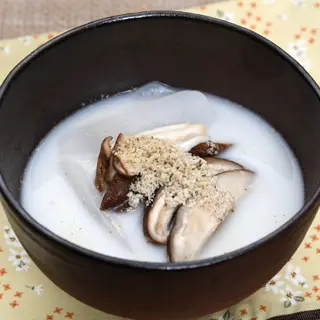
Perilla Seed Konjac Sujebi
Ingredients Tap an ingredient to check it off
- konjac곤약(150g)150 g
- shiitake mushroom표고버섯(1 pc)
- king oyster mushroom새송이버섯(1 pc)
- perilla seed powder들깨가루(200g)200 g
- beef bone broth (sagol)사골육수(400g)400 g
- garlic마늘(5g)5 g
- vinegar식초(0.3g)0.3 g
Nutrition per serving
Steps
Translated from the Korean original. Amounts are as in the original recipe.
- Slice the konjac thin.
- Add a drop or two of vinegar to boiling water and blanch the sliced konjac.
- Soak the shiitake mushroom and julienne it.
- Mince the garlic and stir-fry it in a pot.
- Add the shiitake and king oyster mushrooms to the pot and stir-fry together.
- Add the perilla seed powder and beef bone broth to the pot and boil, then add the blanched konjac and boil a little longer.
Diet and allergy labels are estimated from the ingredient list. Check labels if you have an allergy.
Recipe source: Korea Ministry of Food and Drug Safety (MFDS) recipe database. English translation by WorldFoodPedia, not by MFDS.
Community recipes
No community recipes yet.
Sign in to share recipes, rate and comment.
Share your recipe for Sujebi
More dishes from South Korea
View all Recipe
 Recipe
 Recipe
 Recipe
 Recipe
 Recipe
 Recipe
 Recipe